The Zodiac Through Art and History: Two Thousand Years of Celestial Symbolism
The twelve signs of the zodiac — the belt of constellations through which the sun appears to travel in the course of a year — have been depicted, interpreted, and encoded in art for at least three thousand years. From the circular zodiac carved on the ceiling of the Hathor temple at Dendera in Egypt (one of the oldest surviving circular astronomical maps, dating to approximately 50 BCE), through the medieval zodiac man who mapped the constellations onto the human body, through the woodcuts of 16th-century German printers and the baroque engravings of 17th-century astronomical atlases, to the horoscopic wheel of modern astrology — the zodiac has been the most persistent symbolic framework in Western civilization, outlasting empires, surviving the Copernican revolution, and continuing to organize the sky for a majority of the world's population who consult it today.

The Dendera Zodiac, Louvre Museum (c. 50 BCE) — carved on the ceiling of a chapel in the Temple of Hathor at Dendera, Egypt; the oldest substantially complete circular zodiac in existence; the twelve signs appear alongside Egyptian decans, planets, and the circumpolar constellations in a complete astronomical map of the sky

Dendera Zodiac — the constellation diagram showing which figures correspond to which astronomical positions; the Dendera zodiac combines the twelve Babylonian zodiac signs with 36 Egyptian decans (ten-degree segments of the ecliptic), creating a synthesis of two independent astronomical traditions

Lunar eclipse recorded in the Dendera Zodiac — scholars have used the astronomical data encoded in the zodiac (planetary positions, eclipse records) to date it with precision to 50 BCE; the ancient Egyptians were using their celestial ceilings as permanent astronomical records

The Zodiac Man, Très Riches Heures du Duc de Berry (c. 1415) — the human body mapped onto the twelve signs of the zodiac; Aries governs the head, Taurus the neck and throat, Gemini the arms and shoulders... down to Pisces governing the feet; medieval physicians used this chart to determine auspicious times for bloodletting and surgery

German Zodiac Woodcut (16th century) — the printing press democratized astrological knowledge that had previously been confined to manuscript tradition; almanacs and zodiac charts became mass-market publications, making the celestial calendar available to every literate European household

The Dendera Zodiac — 19th century engraving of the original relief, made before its removal to the Louvre in 1821; the French Egyptologist Édouard Jomard identified and published it during Napoleon's Egyptian campaign; its removal from Dendera caused a public controversy that anticipated modern debates about cultural heritage repatriation
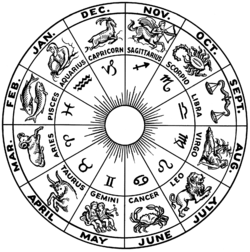
The modern horoscopic zodiac wheel — the 360-degree circle divided into twelve 30-degree signs, each associated with a ruling planet, element (fire, earth, air, water), and modality (cardinal, fixed, mutable); despite the Copernican revolution, Western astrology retained the geocentric perspective as its operational framework

The twelve zodiacal constellations in astrophotography — what the astrologer inherited from the astronomer: twelve groups of stars that appear along the ecliptic, named for the figures that ancient Mesopotamians saw in their patterns; the zodiac as it actually appears in the night sky, beneath all the symbolic weight that two thousand years have placed upon it

The ecliptic — the plane of Earth's orbit around the sun, the path along which the sun appears to move through the zodiacal constellations over the course of a year; the foundation of all zodiacal astrology is this simple geometric fact: from Earth, the sun appears to pass through twelve different star-groups in twelve months


Comentarios