Très Riches Heures: The Most Beautiful Book in the World
The Très Riches Heures du Duc de Berry — commissioned by John, Duke of Berry, and painted primarily by the three Limbourg Brothers (Pol, Herman, and Jean) between approximately 1412 and 1416, then completed after their deaths by other masters — is the most celebrated illuminated manuscript in existence, and arguably the greatest single artifact of medieval European art. Its calendar pages alone constitute a revolution: for the first time in Western art, the months of the year are depicted as real landscapes with real peasants doing real seasonal work, under real skies painted with the astronomical precision of people who had studied the heavens. The devotional imagery that accompanies the calendar — the Hours of the Virgin, the Office of the Dead, the prayers for each canonical hour — represents the full spiritual universe of late medieval Christendom, compressed into a book small enough to hold in both hands.

The Anatomical Man (Zodiac Man) — the human body mapped onto the twelve signs of the zodiac, showing which sign governs which organ; this image encodes the medieval understanding of the cosmos as a body and the body as a cosmos — macrocosm and microcosm in perfect correspondence

January — the Duke of Berry feasting with his court; the tapestry behind him shows a battle scene; above, the zodiac band shows Capricorn and Aquarius; the calendar pages are simultaneously devotional art, astronomical chart, agricultural manual, and courtly portrait
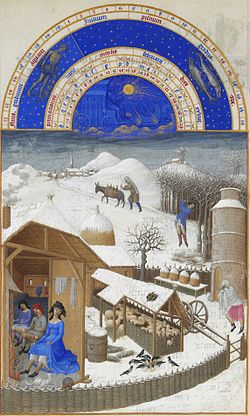
February — peasants warming themselves by a fire inside a house, sheep in the snow, a village in the distance; the unsentimental honesty of the Limbourgs' depiction of winter poverty is as remarkable as the technical brilliance of the snowscape, one of the earliest convincing depictions of snow in Western art
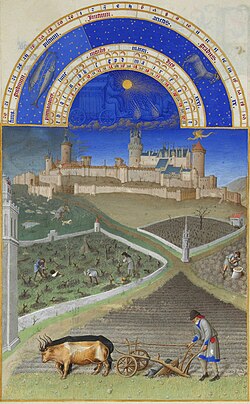
March — peasants plowing and sowing under the castle of Lusignan; the château in the background is the legendary home of Melusine, the water fairy from whom the Lusignan dynasty claimed descent; myth and daily labor coexist in the same landscape
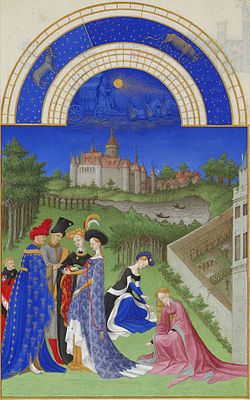
April — a betrothal ceremony in a flowering garden, the château de Dourdan in the background; the spring month is rendered as a scene of aristocratic courtship and renewal, the sacred calendar mapped onto the cycles of human love

May — the May Day procession of courtiers on horseback through a flowering forest; the garlands of green leaves (the May garland) represent the ancient pre-Christian celebration of spring's return; the Limbourgs painted the pagan heart of European seasonal ritual inside a Christian devotional book

June — hay-making on the banks of the Seine, the towers of the Sainte-Chapelle and the royal palace visible across the river; the precision of Parisian topography in 1415, combined with the timeless rhythm of agricultural labor, makes these pages documents of both sacred time and lived history

July — harvesting and sheep-shearing under the castle of Poitiers; the intense summer light, the postures of the working figures, the depth of the landscape — the Limbourgs achieved a naturalism a generation before the Italian Renaissance claimed it as its own discovery
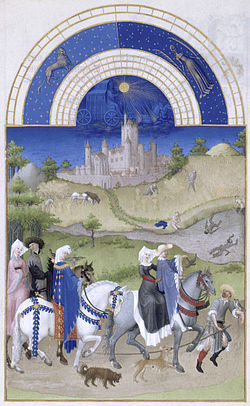
August — hunting and bathing at the castle of Étampes; the naked figures in the river mark one of the first depictions of swimming in Western art; the sacred calendar accommodates the full range of human activity, from prayer to naked pleasure in a summer river
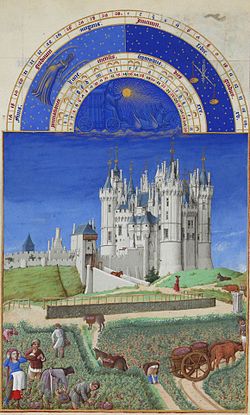
September — grape harvest at the château de Saumur; the castle's towers rise in extraordinary detail behind the vineyards; the harvest is a sacred act, the transformation of the grape into wine a sacramental process whose end is the Eucharist — the spiritual meaning embedded in the physical labor

October — sowing wheat before the Louvre; the faithfulness of the Limbourgs' depiction of the medieval Louvre (then a royal palace, not yet a museum) makes this page an invaluable historical document — the art of memory serving both devotion and history

December — the boar hunt at the forest of Vincennes; the cycle of the year ends as it began, with the aristocracy at their pleasures and the peasants at their labor, the wheel turning under the same zodiac band that governs both — the great equalizer that no rank can escape


Comentarios