Viking Ships: Longboats and the Sacred Sea
The Viking ship is simultaneously a technological achievement, an art object, and a sacred vessel. The longship (langskip) — clinker-built, shallow-drafted, symmetrical (capable of sailing in either direction), its prow often carved in the form of a dragon or serpent — was the instrument of the Norse world's radical expansion between approximately 790 and 1100 CE: to Iceland, Greenland, North America, the British Isles, France, the Mediterranean, the Black Sea, and Constantinople. But the ship was not merely a tool of movement. In Norse cosmology, the sea was a domain of chaos and power between the ordered worlds; to cross it was to pass through the realm of possibility, to risk the transformative encounter with the unknown. The greatest Norse leaders were buried in their ships — the Gokstad burial (c. 900 CE) and the Oseberg burial (c. 834 CE), discovered in Norway in the 19th and early 20th centuries, are two of the most extraordinary archaeological finds in Scandinavian history. The ship, in death as in life, was the vehicle of passage between worlds.

The Oseberg ship, Viking Ship Museum, Oslo (c. 820 CE) — the best-preserved Viking Age ship in the world, 21.4 meters long, built of oak with extraordinary craftsmanship; buried as the tomb of a high-status woman (possibly Queen Åsa of Norway), it contained two female skeletons, 15 horses, 6 dogs, and an extraordinary assemblage of decorated objects

Oseberg ship prow detail — the spiral carving of the prow demonstrates the extraordinary quality of Oseberg woodcarving; the Oseberg burial contained not only the ship but objects decorated in the Oseberg art style, one of the great decorative traditions of the Viking Age: interlaced animals and geometric patterns of astonishing complexity and quality

Animal head post, Oseberg burial, 9th century — five elaborately carved animal head posts were found in the Oseberg burial, their function unknown; the most famous, the 'Academician's Head,' shows an animal of terrifying expressiveness whose eyes seem to follow the viewer; Norse sacred art consistently represents the boundary between animal and divine as permeable
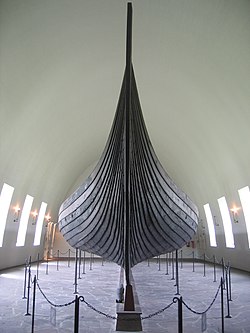
The Gokstad ship, Viking Ship Museum, Oslo (c. 890 CE) — 23.8 meters long, built for open-sea sailing; a replica sailed across the Atlantic in 1893 in 27 days, demonstrating the extraordinary seakeeping ability of the design; the Gokstad burial contained the skeleton of a man approximately 40 years old, killed in battle, surrounded by horses, dogs, peacocks, and three small boats
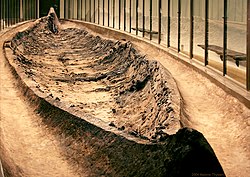
The Ladby ship burial, Denmark (c. 925 CE) — the only Viking ship burial found in Denmark, where the ship itself was not excavated but its ghost remains in the soil as a perfectly preserved impression; the bronze anchor and iron chain that moored the ship in death are still in place; the burial contains the remains of horses and dogs but the human remains may have been disturbed by early grave robbers

Skuldelev ships, Viking Ship Museum, Roskilde — five ships deliberately sunk in the Roskilde Fjord around 1070 CE to block the approach to Roskilde; excavated in 1962, they represent different ship types (ocean-going trading vessel, coastal trader, warship, ferry) demonstrating the full range of Viking maritime technology

Snekkja longship replica under sail — a modern reconstruction of a Viking Age longship showing the square sail that supplemented the oars for open-sea sailing; the Vikings could average 150-200 kilometers per day under favorable conditions, a speed not surpassed by sailing ships until the 19th century; their ships were the fastest and most maneuverable vessels of their era

Viking Age weathervane — used to indicate wind direction at the ship's prow, these gilded bronze weathervanes were sacred objects as much as navigation tools; the four holes at the corners were for pennants; the dragon or serpent form of many ship prows was not merely decorative — it was apotropaic, warding off the sea-spirits who threatened the vessel in the chaos between worlds


Comentarios