The Chaldean Oracles: Theurgic Ascent, the Cosmic Soul, and the Fire of the Father
The Descent of the Mystical Fire: The Origin of the Oracles
In the twilight of the second century of the common era, under the reigns of Marcus Aurelius and his successors, a collection of hexameter verses emerged that would redefine the spiritual trajectory of the Mediterranean world. Known as the Chaldean Oracles, these fragmentary revelations were attributed to Julian the Chaldean and his son, Julian the Theurgist. Unlike the rational, discursive philosophy that characterized the classical Athenian academies, these verses did not invite debate. They demanded ritual participation, claiming to be direct transmissions from the paternal Intellect, channeled through the medium of the cosmic elements.
Before the emergence of the Oracles, the seeker of truth pursued theology—the logical, intellectual discourse concerning the nature of the divine. The Oracles, however, introduced the concept of theurgy (theourgia), which translates literally as "divine work." Theurgic practice did not aim to explain the gods, but to cooperate with them, using the material structures of the cosmos as mirrors to draw the divine presence down into the earthly sphere. In this philosophical framework, the human intellect alone was deemed insufficient for salvation. The soul, heavy with the dense matter of the sublunary realm, could not think its way back to the heavens; it had to be lifted by the active, operational power of the gods, mediated through ritual signatures placed in the fabric of creation.
The Triadic Architecture of the Cosmos
The cosmology of the Chaldean Oracles is deeply hierarchical, organized around a primordial, triadic structure that prefigures later Neoplatonic developments. At the summit of this universe stands the Father (the paternal Intellect), a silent, self-contained source of all existence. The Father does not directly engage with the lower realms of matter, remaining in a state of perpetual contemplation and absolute transcendence. He is the font of all light, the primary will, and the source of the divine fire that animates the spheres.
From this silent source emanates the second principle, the Second Intellect, also known as the Creator or the Demiurge. This active intellect is the builder of the physical universe, the force that translates the abstract thoughts of the Father into geometric forms and structural laws. The Demiurge acts as a bridge between the supreme unity of the first principle and the multiplicity of the lower worlds.
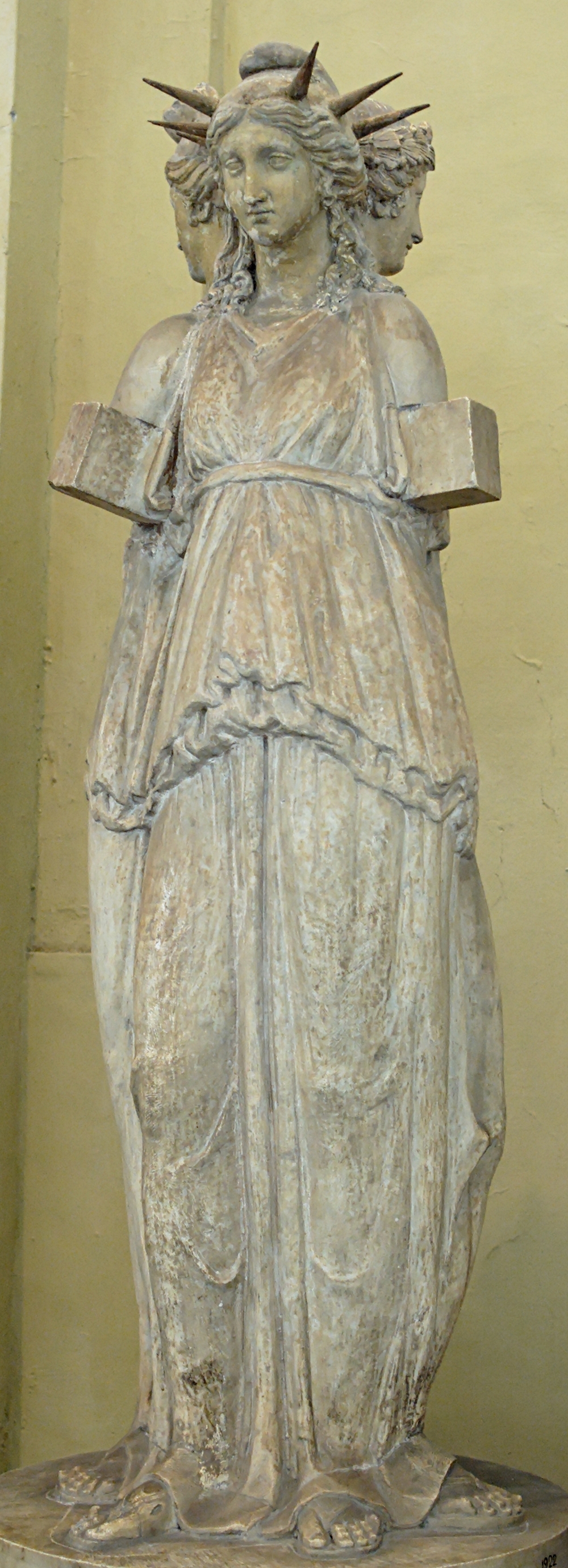
Crucially separating these two intellects, and acting as the boundary between the intelligible and sensible worlds, is the Cosmic Soul, personified as the goddess Hecate. In the Oracles, Hecate is not the sinister deity of classical witchcraft, but the universal womb of form, the central channel through which the divine fire flows from the Father to the physical universe. She is the mediator of the celestial winds, the source of life, and the repository of the ideas that shape the material elements. Her triple-bodied form represents her dominion over the three primary realms of existence: the celestial, the terrestrial, and the sublunary.
The Paternal Fire and the Heavy Atmosphere of Earth
In the Chaldean system, the universe is filled with a spiritual, cosmic fire that represents the purest form of reality. The stars, the sun, and the planets are composed of this fiery substance, which acts as the vehicle of divine consciousness. As this light descends from the heights of the Empyrean, it passes through the starry spheres, gradually becoming dense, heavy, and obscured as it reaches the sublunary world.
The sublunary realm—the earth and its surrounding atmosphere—is described as a place of moisture, darkness, and decay. Here, the spiritual fire of the human soul is encased in a heavy, physical body, surrounded by material forces that seek to drag it down into oblivion. The Oracles warn the practitioner to flee the "muddy depth" of the material world, which is governed by hostile, terrestrial forces that distract the mind and fragment the attention. The body is seen as a garment of skin, a vessel of clay that binds the soul's native spark to the wheel of generation.
To free this spark, the theurgist must learn to recognize the symbola and synthemata—the divine signatures that the Demiurge has sown throughout the physical world. These signatures are present in certain stones, plants, animals, and vocal sounds. They are material echoes of the divine ideas, vibrating at the same frequency as the celestial fire. By gathering these symbols and organizing them in ritual space, the theurgist creates a sympathetic resonance that opens a channel of communication between the earthly plane and the divine intellect.
The Tools of the Theurgist: Iynges and the Breath of the Sun
The ritual practice of Chaldean theurgy involved several specialized tools and techniques designed to activate the sympathetic chains of creation. Among the most important of these were the iynges (singular: iynx), which were small, golden wheels or discs inscribed with magical characters. The theurgist would spin these wheels using leather thongs, mimicking the rotation of the planetary spheres and chanting vocal incantations. As the disc spun, it was believed to act as a cosmic transmitter, attracting the divine fire and drawing the attention of the gods down to the ritual chamber.
In addition to the physical tools, the theurgist practiced deep, meditative breath control, visualizing the inhalation of solar rays. Facing the rising sun, the practitioner would breathe in the air, visualizing the light as a vital, spiritual force (pneuma) that filled the lungs and expanded the internal vehicle of the soul. This practice was not merely a physical exercise, but a method of pneumatic tuning, aligning the individual's breath with the great cosmic winds that flow from the womb of Hecate.
During these rituals, the practitioner would chant long strings of vowels and words of power, known as the voces magicae. These sounds were not understood as human language, but as phonetic representations of the planetary frequencies. To speak these vowels in the correct rhythm and tone was to strike a chord on the cosmic lyre, dissolving the boundaries of the local ego and aligning the internal consciousness with the primary pulse of the Divine Mind.
The Ascent of the Soul and the Liberation from Fate
The ultimate goal of Chaldean theurgy was the ascent of the soul (anagoge) back to the Empyrean realm. The Oracles describe the human soul as possessing a subtle, energetic body, the ochema or pneumatic vehicle. During its descent through the planetary spheres, the soul gathers the heavy qualities of each planet, which attach to this pneumatic vehicle like weights. In its physical incarnation, the soul is bound by the laws of fate (heimarmene), which are governed by the planetary movements and the terrestrial elements.
By performing the theurgic rituals, the practitioner begins the process of purification, gradually shedding these planetary weights. The ritual fire burns away the heavy moisture of the sublunary atmosphere, restoring the native buoyancy of the pneumatic vehicle. As the soul rises through the planetary gates, it leaves behind the passions associated with each sphere, returning to its primordial state of fiery purity.
The culmination of the ascent is the face-to-face encounter with the Father. In this state of absolute alignment, the practitioner is freed from the deterministic laws of fate, realizing their identity as a spark of the divine fire. The Oracles celebrate this triumph over the material veil, promising that the theurgist who has successfully ascended will dwell in the light of the Empyrean, unified with the source of all existence.
Lux Esoterica.
2026.


Comentarios