Alkonost and Sirin: The Twin Birds of Paradise Whose Songs Divide Joy from Oblivion
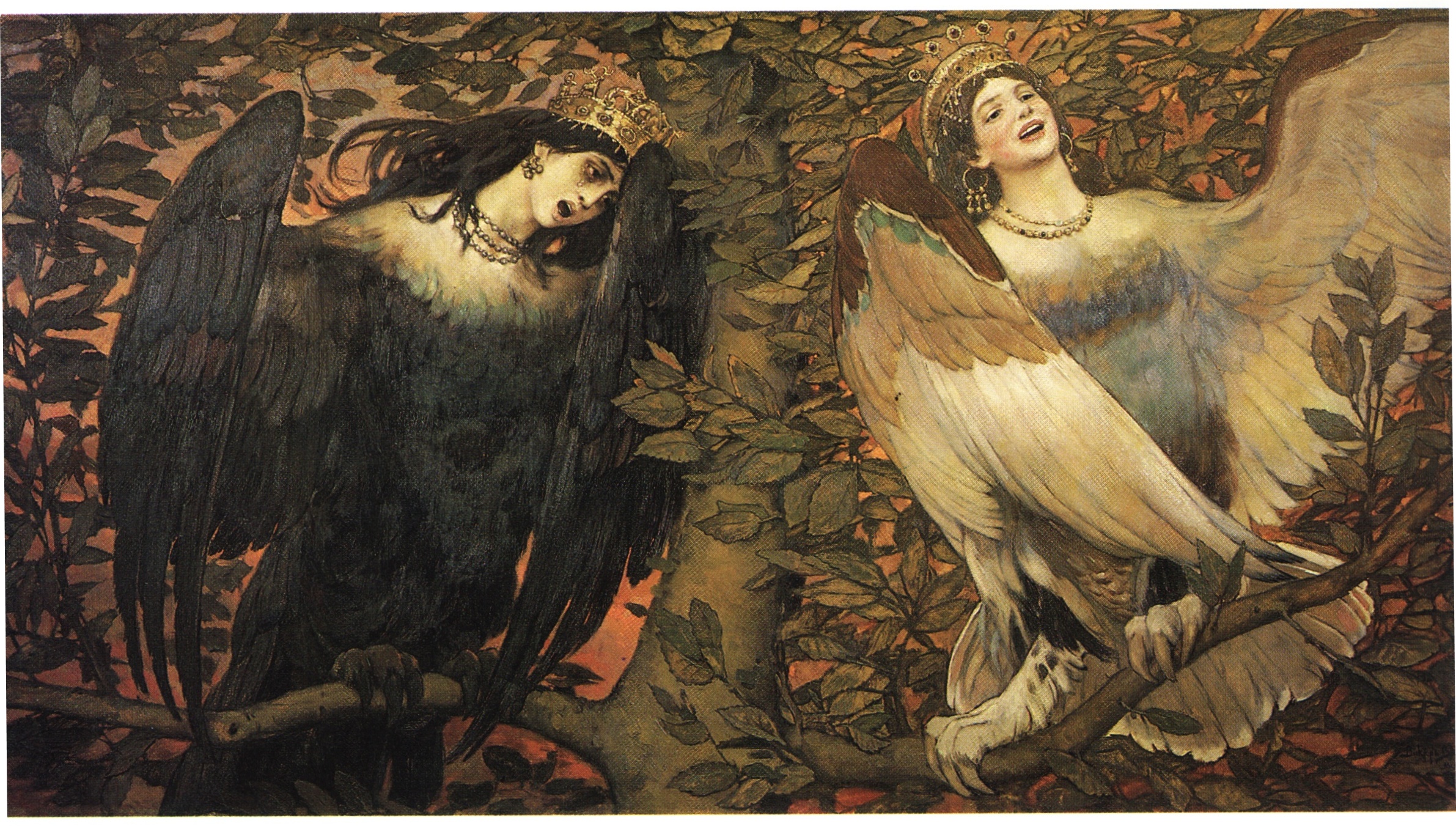
In 1896 Viktor Vasnetsov painted two great birds perched in the branches of a single tree, and gave Russia back one of its oldest dreams. Both birds wear the faces of women. One, plumed in black, her cheeks flushed with rapture, sings with parted lips and eyes wide open upon some unbearable gladness; the other, radiant white, crowned, sings with her eyes shut, and tears stand on her lashes. He called the canvas Sirin and Alkonost: Birds of Joy and Sorrow—and then, as if to warn us that the dream resists our tidy labels, the tradition itself cannot finally agree which bird is which. For these are the twin bird-maidens of the Russian paradise: creatures blown out of Byzantine Greece into the Slavic imagination, nested for centuries in illuminated bestiaries, spiritual songs, and the cheap woodblock prints called lubki that peasants pinned to their walls—and their doubled song divides, with terrible precision, the two things a human being may feel when heaven brushes too close: joy that saves, and sweetness that annihilates.
The Bird of the Halcyon Days
Alkonost entered Russia by way of a scribe's slip of the pen—one of the most fruitful clerical errors in the history of symbols. The Greeks told of Alcyone, daughter of the wind-king Aeolus, who, losing her husband to the sea, threw herself upon the waves and was changed by the gods' pity into the kingfisher—alkyon—that nests, they said, upon the calm sea itself. For her sake the winds are chained twice a year: the halcyon days, that miraculous stillness around the winter solstice when the deep goes glassy so the kingfisher may brood her eggs upon the water. Slavonic bookmen, translating the Byzantine commentaries and bestiaries, fused the phrase alkyon esti ("it is the halcyon") into a single wondrous name—Alkonost—and the meteorological marvel of the Greeks hatched, on Russian soil, into a bird of paradise with a maiden's face.
The old Russian bestiary keeps the sea-nesting faithfully and transfigures it. The Alkonost dwells in Iriy, the paradise of the East, but descends in midwinter to lay her eggs at the edge of the sea. She sinks them into the deep—seven days they lie in the abyss—and while her eggs rest in the water, the sea is windless and still: the sailor's calm is the brooding of the paradise-bird. Then the eggs rise, hatch upon the surface, and the storms may resume their office. Read that emblem slowly, for it is a whole theology in miniature: the world's rare seasons of peace are not vacancies of weather but incubations—somewhere a holy thing has laid its future in the deep, and the tempests are held back until it hatches. When the calm ends, it is not that grace failed; it is that something was successfully born.
The Bird Who Sings Men Out of Themselves
Sirin, her twin and shadow, needs no etymology to unmask: she is the Greek Siren, flown north and baptized—though the baptism never entirely took. In the Russian bestiaries and the spiritual verses she too dwells in paradise, or upon its borders; her plumage is glory, her face a maiden's of unearthly beauty, and her song is the song of the blessed—the very sounds of the joy prepared for the righteous. And precisely there lies her danger. For the man who hears the Sirin sing forgets everything. He forgets bread, kin, labor, name; his soul goes out of him toward the sound as wax toward flame; he follows, and wanders after her until he falls dead—unmarked, unmourned, empty. The old prints show sailors and travelers stopping their ears, firing cannon, ringing bells, blowing trumpets to frighten the paradise-bird away—men making a saving din against beatitude itself, because the sweetness of heaven, taken before heaven and without preparation, does not sanctify the unready soul: it evacuates it.
Later folklore, softening toward her, said the Sirin sings only to the holy, and flies from the sinful; the nineteenth century made her simply the Bird of Joy, and hung her in the lubok beside her sister as a domestic blessing. But the older stratum is the more precise instrument. In it, Sirin and Alkonost are not Joy and Sorrow, but something subtler: two ways the absolute arrives in a mortal ear. The Alkonost's song brings a gladness after which one returns to the world—chastened, stilled, able to plough. The Sirin's song brings a sweetness after which one cannot return at all. The first is grace proportioned to the vessel. The second is the vessel's dissolution—blessedness at a voltage flesh was never wound to carry. The peasants with their cannon understood what the mystics' manuals spell out in fine print: there is an ecstasy that is theft, and the soul must sometimes be defended against premature paradise as against any other robber.
The Apple Feast and the Third Sister
The folk calendar caught the two birds and set them, with perfect instinct, into the turning of the orchard year. On the morning of the Apple Feast of the Saviour—the Transfiguration, the nineteenth of August, when the first apples are blessed in church and none are eaten before—the Sirin flies into the apple orchard first. She sings, and she weeps; for hers is the sadness of the old age of the year, and the tradition says the apples she brushes carry peril. But at midday the Alkonost comes, singing and laughing; she shakes from her wings a living dew, and every apple she touches becomes a fruit of blessing, of healing, of strength. Only then are the apples gathered for the blessing-baskets. The two paradise-birds thus preside over the most tender of Russian feasts—the day the summer breaks—one bird mourning what ripening costs, the other consecrating what ripening yields. No liturgical commission ever devised a finer image of the Transfiguration itself: the same orchard, the same light, and the difference between the fruit that saddens and the fruit that heals decided by which song has touched it.
The bestiaries gave the sisters a third: Gamayun, the all-knowing herald-bird of the Eastern isle, who proclaims the fates of heroes and remembers the origins of earth and heaven, of gods and men, singing the old cosmogonies to those who know how to ask. Joy that stills the sea, sweetness that unselves the hearer, knowledge that recites the beginnings: the three bird-maidens divide among themselves the entire traffic between paradise and the Russian ear. They roost, all three, in the branches of the world-tree of the old Slavic songs—that axial oak upon whose crown sit the birds of heaven and at whose roots the dark powers coil; the same tree, the incantations say, that stands upon the island of Buyan in the middle of the ocean-sea, where the deepest Russian mysteries keep their treasury — and the road to their island runs past the hut of the old initiatrix of the forest, Baba Yaga, who examines all travelers to the deeper east.
The Two Songs Within
What shall the esoteric reader carry home from the paradise-tree? This, perhaps. The tradition insists that the birds are twins—one tree, two songs—and that mistaking them is the characteristic accident of the spiritual life. Every practitioner who has gone any distance knows both visitations. There is the Alkonost-touch: the consolation that arrives mid-grief like windless water, the stillness in which something long-laboring in the deep of us is finally permitted to hatch—after which we stand up and return to our nets, quieter and stronger. And there is the Sirin-touch: the rapture that asks us to forget the nets, the bread, the kin, the body—the sweetness that would have us follow it out of the human estate altogether, and that leaves those who follow it unripened, scattered, lost to their own lives while still walking around in them. The old Russians ringing bells against the Sirin were not philistines deaf to heaven. They were practicing the rarest of the discernments: telling the joy that incubates from the sweetness that devours, the song after which one ploughs from the song after which one wanders. Vasnetsov, painting his two birds, gave the black-winged singer the open, blazing eyes and the white-crowned one the closed and weeping lids—and critics have argued ever since about which is joy, which sorrow. The argument is the lesson. From the branch, the two songs are almost one song. Only the orchard tells them apart: by evening, some apples heal, and some are better left ungathered.
The lubok-makers printed the sisters by the thousand, bright as playing cards, and the peasants nailed them over the stove: paradise domesticated, the terrible discernment turned into wallpaper—and yet not quite. For the woodcuts kept the old inscriptions: whosoever hears this bird's voice forgets all his life... A warning, pinned up at the exact center of the household, beside the icons and the bread. Joy that stills the storm so the deep can brood; sweetness that empties the man so the wandering can begin; and between them, every day of an ordinary life, the human task the twin birds define by flanking it—to keep an ear open toward paradise, and both feet in the orchard, until the apples are blessed.
Lux Esoterica.
2026.


Comentarios