Libuše: The Prophetess Who Founded Prague in Czech Legend
Most of Europe's capitals were founded by soldiers, merchants, or accidents. Prague, by its own account, was founded by a trance. The Czech chronicles—Cosmas of Prague in the early twelfth century, embroidered by all his successors—tell that in the days before history, the lands of the Czechs were judged by Libuše: youngest of the three daughters of the patriarch Krok, and the wisest; her eldest sister Kazi knew herbs and healing, the second, Teta, taught the worship of the powers, but Libuše saw—forward, into what had not yet happened—and for her seeing and her justice the people chose her, a woman, to judge the nation from her seat at Vyšehrad, the high castle on its rock above the Vltava. Her legend contains, in three linked movements, a whole constitution: how she lost the judgeship to an insulted man's sneer; how she chose a plowman for a husband and made him a dynasty; and how, standing on the rock above the river, she fell into the prophetic seizure and spoke the founding sentence of a city: I see a great city, whose glory will touch the stars. Every element of the tale is doing serious work; and at the bottom of it, held in reserve like the crown jewels it guards, sleeps the legend's last movement—the knightly host inside the mountain, waiting for the worst hour of the nation to ride out. Bohemia put its entire theory of power into one woman's three visions, and then set the story to music and made it the national opera. It repays the closest reading the esoteric tradition can give it.
The Insult and the Plowman
The first movement is a courtroom. Two neighbors—landholders, hotheads—bring Libuše a boundary dispute; she judges it on the merits; and the loser explodes with the sentence the chronicle preserves like a splinter of real, ancient venom: Woe to a nation ruled by a woman! Long hair, short sense! Libuše does not argue. She tells the assembly, with a seer's terrible mildness, that they do not know their good fortune—a woman's hand is light; iron rules await you if you want a man—and, since they want one, she will tell them where to find him. And here the legend rises onto its deepest ground. She names the place unseen: beyond the mountains, by the river Bílina, a village called Stadice; in the village, a fallow field; in the field, a man plowing with two spotted oxen. His name is Přemysl—"the one who thinks ahead," the very name a prophecy. Her white horse, loosed, will lead the envoys; they are to follow it, bow to the plowman, and hail him prince. It happens exactly so: the horse walks to Stadice as if going home (the sly old chroniclers hint the road was not new to it); the envoys find the plowman; and Přemysl, in the scene every Czech schoolchild knows, drives his ox-goad of hazel into the earth, where it sprouts leaves before their eyes—three shoots, of which two wither and one thrives: three dynasties' worth of omen in a walking stick—and unyokes the oxen, which vanish into a rock. The plow stands in the furrow, the field half-finished; and Přemysl speaks the founder's sentence: had he been allowed to finish that plowing, bread would never have failed in Bohemia; but the field is unfinished—and therefore hunger will visit the land from time to time. Then he goes with them, marries Libuše, and founds the Přemyslid dynasty, which ruled the Czech lands in unbroken male line for over four centuries of recorded history—every king of it, the legend never tired of repeating, descended from a plowman fetched from his furrow by a prophetess's horse.
The Vision on the Rock
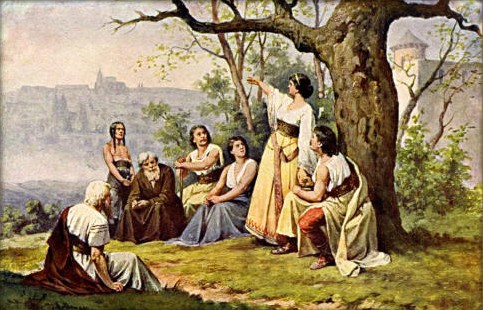
The second movement is the founding. Standing with Přemysl and the elders on the cliffs of Vyšehrad, Libuše falls into the prophetic state—the chronicle says she was seized—and points across the wooded hills downriver: there, where a man is even now hewing the threshold of a house (práh, in Czech), they are to build a castle and a town, and because even princes bow when they cross a threshold, the town shall be called Praha—Prague, the Threshold—and I see a great city, whose glory will touch the stars. The etymology is the legend's own; the philologists have other candidates; and the esoteric reader should decline to let the philologists spoil the point, for the legend chose its false etymology with the instinct of genius. The capital of Bohemia is named, by its founding myth, Threshold: the city as crossing-place, the seat of power as a liminal stone that even sovereigns must bow to pass—a nation whose central place is not a fortress-name or a victory-name but the name of the humblest sacred object in any house, the beam under the door. Libuše's other prophecies filled out the map: the mineral wealth under the hills, the fates of dynasties—and the tradition made her also the keeper of the darker ledger, foreseeing the invasions and agonies to come, which is why the legend's final movement exists.
The Sleeping Host and the Speaking River
For Czech tradition did not let the founding family die. When the last need comes—when the homeland stands at its worst hour—the knights of Blaník will ride: a whole army asleep inside Blaník mountain, and at their head, in the fullest tellings, the sainted Wenceslas on his white horse; the mountain opens, the host rides out, and the enemy is broken at the last. It is the Czech chapter of the great sleeping-army doctrine of Europe—the same reserve of deferred sovereignty that Germany banks under the Kyffhäuser and Britain in the isle of Avalon, where the once and future king awaits his own last summons—and Libuše stands at the head of its lineage: the prophetess who saw the glory also saw the extremities, and the tradition that begins with her trance on the rock ends with the nation's whole strength banked underground against the hour her seeing found at the far edge of the future. When the composer Smetana built the national opera Libuše for the opening of the National Theatre in 1881, he ended it exactly there: the seeress, in the finale, prophesying the trials of the nation one by one—and past them, the endurance; the opera is performed, by tradition, only on the days of national significance. A legend that began as a chronicler's tale had become, by the nineteenth century, the liturgical instrument of a people's self-founding: sung, on the great days, from the stage of a theatre the nation built by public subscription for precisely this purpose.
The Esoteric Reading: The Seeress, the Plowman, and the Threshold
Read as the mystery-text it is, the Libuše cycle lays out a complete doctrine of legitimate power, clause by clause. The seer judges until judgment is insulted: intuition governs lightly and well, and is deposed not by failure but by the loser's contempt—whereupon it does not cling to office; it chooses its successor, and warns, in the legend's most quoted line, that those who reject the light hand will get the iron one. Power is fetched from the furrow: the sovereign the deep selects is found mid-labor, thinking ahead, in an unfinished field—and the unfinished field is the legend's sternest clause: rule accepted before one's own plowing is done imports that unfinishedness into the realm forever; hunger returns to Bohemia because the founder left his furrow. Every soul that has taken up authority with its own field half-plowed knows the tax. The dry staff flowers: the hazel goad leafing in the earth is the universal sign of election we have traced from Aaron's rod to Glastonbury—life declaring itself through the dead instrument at the moment of true calling. And the city is named Threshold: the final teaching, and Bohemia's own. What the seeress founds at the height of her trance is not a citadel but a crossing-place—power conceived as the beam under the door, the thing everyone, prince and peasant, must bow to pass; glory that touches the stars is prophesied precisely for the city humble enough to be named after the stone underfoot. The feminine deep sees and names; the laboring hand governs and descends from her; the capital between them is a threshold; and the last reserve of the whole arrangement sleeps in a mountain, on call. It is as complete a political esotericism as Europe possesses, and it was assembled by chroniclers who thought they were writing history.
Vyšehrad still stands on its rock over the Vltava, with the legendary sites duly signposted and Smetana buried in the cemetery at the top; the ox-goad's descendants, the story says, grew at Stadice within memory; and Prague below has done what the trance said it would. The legend asks of its readers what Libuše asked of her envoys: trust the white horse—the instinct that already knows the road; bow to the plowman—the competence found mid-furrow, thinking ahead; finish your field before you leave it, or budget for the hunger; and when you found anything—a city, a work, a life—name it, and build it, as a threshold: a thing whose glory may touch the stars precisely because everyone who enters it, sovereign or stranger, must bow their head at the door.
Lux Esoterica.
2026.


Comments