The Jersey Devil: The Cursed Thirteenth Child of the Pine Barrens
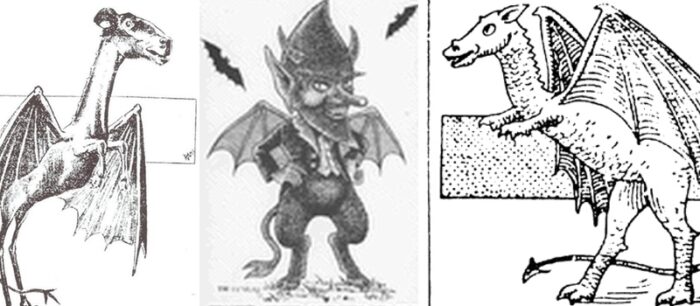
Southern New Jersey hides, between the great cities of the American seaboard, a wilderness that has no business being there: the Pine Barrens — more than a million acres of stunted pines, sugar-sand roads, and tea-dark cedar water, a sparsely settled inland island of forest wedged against the most crowded corridor of the continent. Every wilderness gets the monster it deserves, and the Barrens got theirs early. He is the Jersey Devil — for two centuries before the marketers shortened it, the Leeds Devil — a creature described with remarkable consistency across three hundred years of frightened testimony: the head of a horse or a ram on a body part bird and part beast, leathery bat's wings, cloven hooves, a forked or serpentine tail, and a scream that empties the woods. He is the official demon of the American state of New Jersey in everything but statute — hockey teams bear his name — and his birth certificate, unlike that of most monsters, names his mother.
The Thirteenth Child
The story is fixed in the folklore of the Barrens with the specificity of parish gossip. In 1735 — the date is traditional — a woman of the pines called Mother Leeds, poor, exhausted, and pregnant for the thirteenth time, cried out in the pains of labor the sentence that sealed the legend: "Let this one be the devil!" The child was born, by the kinder tellings, normal — for a moment. Then, before the midwives' eyes, it changed: the infant lengthened, the face stretched to a muzzle, wings broke from the shoulders, hooves from the feet; and the thing killed or scattered those present (in the gentler versions it merely shrieked), swept up the chimney like smoke going home, and vanished into the pines — where, the Barrens people would tell you for the next two centuries, it remains: glimpsed on night roads, blamed for slaughtered livestock, heard screaming over the cedar swamps before disasters and wars.
Historians who have dug beneath the folktale have found it rooted, fascinatingly, in a real and quarrelsome family. The Leeds family were among the earliest settlers of the Jersey shore country; Daniel Leeds, the patriarch, published almanacs in the late seventeenth century laced with astrology and occult cosmology that scandalized his Quaker neighbors, who denounced his work as evil — and his son Titan Leeds continued the almanac (and a famous feud with Benjamin Franklin, who impishly used astrology itself to "predict" Titan's death, then insisted the living man was a ghost). The Leeds family crest, of all things, bore wyverns — winged, dragonlike, cloven-footed heraldic beasts. A locally notorious family, accused of trafficking with dark sciences, wearing a winged devil on its very arms, resident at Leeds Point where the legend places Mother Leeds's cabin: the folklore, scholars suggest, condensed all of it — religious scandal, occult almanacs, heraldic monsters — into a single unforgettable nativity. The devil was born, in other words, not of a woman but of a reputation.
The Week the Devil Ran
For most of its career the Leeds Devil was a regional bogey — invoked to keep children from the swamps, blamed for the odd dead calf. Then came January 1909, and the most concentrated monster panic in American history. Across one astonishing week in the middle of that month, the creature — or something — was reported in more than thirty towns across New Jersey, Pennsylvania, and Delaware. Strange cloven tracks appeared overnight in the snow of Philadelphia and Camden rooftops and yards, wandering over fences and vanishing in the middle of open fields; a Camden police officer and a Trenton city councilman reported a winged, screaming thing; a trolley-full of passengers in Haddon Heights watched it flap over the tracks; mills and schools closed in the pines as workers refused the night roads; posses formed; the Philadelphia Zoo posted a reward for the beast's capture; hoaxers exhibited a painted kangaroo fitted with tin wings. Newspapers up and down the coast ran the story at full froth, and then, as suddenly as it began, the week ended and the devil went back to the pines, leaving behind the permanent modern form of his legend — no longer the Leeds Devil of one cursed family, but the Jersey Devil, property of a whole state's imagination.
Skeptics have offered the standard menagerie — the sandhill crane blundering north, owls in bad light, the hoaxed tracks of pranksters with weighted shoes — and the Barrens have absorbed every explanation without surrendering an inch of belief. Sightings continued through the twentieth century and continue still: the scream in the cedar swamp, the winged shadow over the parkway, the tracks that stop. Like Black Shuck, the demon dog whose fiery passage is still read into every East Anglian storm, the Jersey Devil has become a permanent tenant of his landscape: the Barrens without the devil would be, for the people of the pines, simply not the Barrens.
An Esoteric Reading
Read esoterically, the Jersey Devil is a doctrine about the curse spoken at the threshold — and about what a community does with the children it has already damned. Begin with the words of Mother Leeds, which are the legend's true monster. The curse is uttered at the exact hinge of becoming: in labor, at the crowning of a new life, at the moment when a soul is passing from the hidden world into this one. Every tradition of the old sciences holds that words spoken at thresholds have disproportionate power — the blessing at birth, the vow at marriage, the word at the deathbed — because the threshold is where form is still soft. The thirteenth child arrives at the most malleable instant a human being ever passes through, and receives, instead of a name, a destination: let this one be the devil. The horror of the tale is not that the curse worked. It is that it was, in the exhausted arithmetic of a woman with twelve children and nothing left, almost reasonable — and the legend is unflinching about what despair does when it is given the office of naming: it assigns the newest, most unformed life the role of carrying everything the household can no longer hold.
The number is exact. Twelve is the number of the completed order — the months, the tribes, the hours of the clock's face; the thirteenth is the surplus, the one past completeness, for whom the system has no chair. Folklore across the world eyes the thirteenth of anything with dread precisely because it embodies the question every order fears: what do we do with what exceeds us? Mother Leeds answers as the overwhelmed always answer — the surplus is demonized — and the child obligingly becomes what it was told to be, taking the only exit the naming left open: up the chimney, the household's one aperture to the wild sky, the channel where the hearth's smoke — the home's own darkness — has always gone. The devil does not break down the door to leave. He leaves by the opening the family's own fires made.
And then, the pines. The cursed surplus does not die and does not depart; it relocates to the wilderness at the community's heart — the unconverted interior, the barrens that the tidy seaboard order surrounds but has never absorbed. There it remains for three centuries, screaming before wars, blamed for losses, glimpsed at the edges — the exiled thirteenth living exactly where every banished thing lives, in the undeveloped interior, active on the night roads between the settlements. The panic of 1909 completes the teaching: when the surplus finally surfaces — when the exiled thing walks through the ordered towns for one week — the response is posses, rewards, hoaxes, and hysteria, everything except the one act the legend quietly identifies as never performed: the naming back. No version of the story baptizes the thirteenth child; no telling calls him home. And so he keeps his tenancy, as such exiles always do — for the curse spoken at a threshold, the old sciences warn, can only be lifted at a threshold, and the Barrens are patient, and the chimney still draws.
Lux Esoterica.
2026.


Comentarios