The Redcap: The Murderous Goblin of the Border Castles
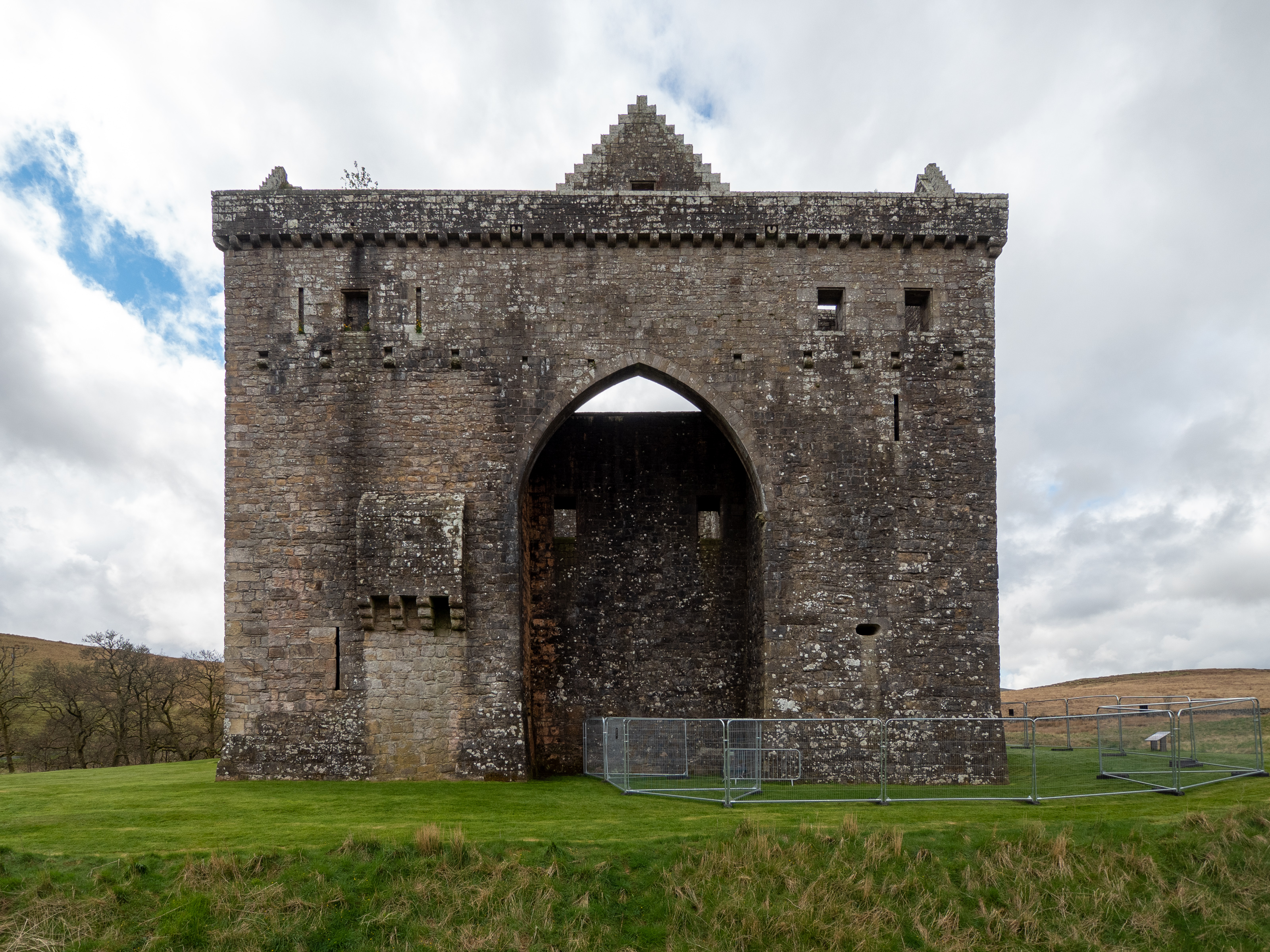
There are haunted places that merely remember violence, and there are places that feed on it. Along the old frontier between England and Scotland — that windswept corridor of moss and moor where, for three centuries, cattle raiders burned one another's farms by moonlight — the ruined towers do not simply remember. Something lives in them still, the old people said. Something short and broad-shouldered, with long grey hair streaming down its back, eyes that glow like embers in a draught, and iron boots that ring on the fallen stones. It carries a pikestaff in its left hand. And upon its head sits a cap the color of a fresh wound, because that is precisely what dyed it.
This is the Redcap, called also the powrie or the dunter, and among all the goblins of British folklore he is perhaps the most unrepentantly murderous. The brownie labors while the household sleeps. The knocker taps warnings to miners in the dark. Even the Kelpie, that drowning horse of the Scottish lochs, kills from something like appetite. The Redcap kills for his wardrobe. His cap must be dyed in human blood, and blood dries. When the color fades, so does he. Murder, for this creature, is not cruelty or hunger or vengeance. It is maintenance.
A Land That Bred Its Own Monster
To understand the Redcap you must first understand the country that dreamed him. The Anglo-Scottish Borders were, from roughly the fourteenth century to the beginning of the seventeenth, one of the most lawless regions in Europe. The great riding families — Armstrongs, Elliots, Grahams, Kerrs — owed allegiance to neither crown so much as to their own surnames, and they raided across the frontier and across the valley with equal enthusiasm. The English and Scottish governments carved the frontier into administrative districts called Marches and appointed wardens to police them, and the wardens raided too. An entire vocabulary grew out of the misery: the word "bereaved" and the word "blackmail" both took shape in Border mouths.
The architecture of the region tells the story more plainly than any chronicle. Ordinary farmhouses were built as small fortresses — peel towers, bastle houses — with walls a meter thick, livestock stabled on the ground floor, and families sleeping above behind a ladder that could be drawn up. When the raiders came, you climbed, barred, and waited. Many of these towers now stand roofless on the hillsides, their stones green with lichen, and it was into these abandoned strongholds that folklore poured its darkest tenant. The Redcap does not haunt just any ruin. He takes up residence specifically in castles and towers where wicked deeds were done — where prisoners starved, where guests were betrayed, where blood soaked into the foundations. He is drawn to old evil the way a wasp is drawn to spilled wine, and he renews it faithfully.
William Henderson, the Victorian folklorist who gathered the traditions of the northern counties in 1866, left us the classic portrait: a short, thickset old man with long protruding teeth, skinny taloned fingers like an eagle's claws, great fiery eyes, grisly hair hanging over his shoulders, iron boots, a pikestaff in his left hand, and the red cap upon his head. The details repay attention. Iron, in most fairy lore, is the one substance the good folk cannot abide — the horseshoe over the door, the nail in the cradle. The Redcap wears it as footwear. Whatever he is, he is not a fairy of the ordinary kind, and the ordinary protections will not serve.
The Cap That Must Be Fed
The mechanism of the legend is brutally simple. A traveler, caught by nightfall or storm, seeks shelter in a ruined tower. The Redcap, who has been waiting — he is always waiting — heaves stones down from the broken battlements and crushes the wanderer where he sleeps. Then the goblin descends, removes his cap, and dyes it anew in the blood while it is still warm. If too long a time passes between victims, the color browns and flakes like any old stain, and the Redcap's own life dims with it. He is, in this sense, less a creature than a covenant: a bargain between violence and vitality, endlessly renewed.
Strength is useless against him. Henderson is explicit that no human hand can resist the Redcap's grip, and the iron boots that ought to make him ponderous somehow do not; he outruns the strongest man over broken ground. There is exactly one recourse, and it costs nothing but courage: quote Scripture at him, or hold up the cross-shaped hilt of a sword. At the sound of holy words the Redcap gives a dismal yell, bursts into flame, and vanishes — leaving behind, on the stone where he stood, a single large tooth. The tooth is a strange, almost tender detail. Demons in the old stories often leave a token of their defeat, a scorch mark or a sulfurous smell, but the Redcap leaves a relic of his own body, as though even in defeat he insists on being remembered as something that could bite.
Robin Redcap and the Wizard of Hermitage
Every legend worth its salt eventually attaches itself to a name and an address, and the Redcap found both in Liddesdale. Hermitage Castle — the vast, grim, almost windowless keep that guards what was once called the bloodiest valley in Britain — belonged in the early fourteenth century to William de Soulis, hereditary butler of Scotland and, if the ballads are to be believed, the wickedest man who ever held land in the Borders. Tradition made him a black sorcerer who bound a familiar spirit to his service: Robin Redcap, the goblin of the castle.
With Robin at his shoulder, the Lord Soulis of legend committed every cruelty the countryside could imagine — seized tenants' children for his rites, murdered guests under his own roof, and mocked all attempts at justice. His familiar had made him proof against ordinary death: no forged blade could cut him and no twisted rope could hang him. The exasperated king of Scots, pestered once too often by petitions, is said to have snapped, "Boil him if you must, but let me hear no more of him" — words spoken in irritation and executed with terrible literalness. The Borderers wrapped Soulis in a sheet of lead, carried him to the stone circle of Ninestane Rig on the moor above the castle, and boiled him in a great brazen cauldron, since boiling was the one death his enchantments had not thought to forbid.
Sober history tells a quieter tale — the real William de Soulis conspired against Robert the Bruce in 1320 and died a prisoner in Dumbarton Castle — but folklore has never let paperwork spoil a good execution. And the legend adds a chilling coda: Robin Redcap was not boiled with his master. He remains at Hermitage, where the castle's evil memory keeps his cap damp, and treasure said to be hidden in the vaults stays hidden because no one cares to negotiate with the doorkeeper.
Dunters in the Walls
Not every Border goblin announces himself with falling masonry. In some towers the presence is only a sound: a steady grinding or beating noise inside the walls, like flax being scutched or barley hulled in a quern. These indwellers the Borderers called dunters, from the old word for a heavy blow, and they were understood to be the Redcap's quieter kin. The sound itself was reckoned an omen — if it grew louder or went on longer than usual, a death or misfortune was coming to the family. One tradition, recorded by the antiquarians, ties the dunters to the deep past: it claims the foundations of the old towers were laid, in pagan centuries, upon the blood of a sacrificed victim to make them stand fast, and that the noise in the walls is that first tenant still working. Whether or not any Border mason ever truly practiced foundation sacrifice, the belief says everything about how the people understood their own architecture — as something that had been paid for in blood once, and might demand interest.
It is worth adding, for fairness, that not every creature wearing red is a killer. Far to the north of the Border country, at Grandtully Castle in Perthshire, tradition speaks of a solitary red-capped spirit dwelling in a tower room whose appearance brings good fortune to the one who sees him — a kind of blessed inversion, proof that the cap alone does not make the monster. And across the sea in the Low Countries, the little kabouters in their red hoods mend pots and tend hearths like any honest brownie. The malice is not in the color. It is in the country. The same red cap that means luck in a peaceful glen means murder in a valley that spent three hundred years teaching its children to count riders on the skyline. Like Black Shuck padding the storm-lashed coast of East Anglia, or the Dullahan riding the Irish night roads, the Redcap is a landscape's fear given feet.
An Esoteric Reading
Read with the inner eye, the Redcap is one of folklore's most precise portraits of how violence perpetuates itself. He does not create evil; he inhabits it. He seeks out places where cruelty has already been done and makes himself its steward, and his single need — fresh blood to keep the old stain vivid — is the exact mechanism of every feud the Borders ever knew. A raid demands a reprisal; a killing demands a killing; the stain must be kept wet, or the whole grim edifice of hatred fades, and fading is the one thing it fears. The Redcap is vendetta wearing boots.
His iron footwear deepens the symbol. Iron repels the fair folk because they belong to the old, soft, growing world; the Redcap wears the metal of weapons and locks because he belongs to the world men built when they stopped trusting one another. He is not nature's spirit. He is history's.
And the remedy is exact. You cannot outfight him, because no one has ever ended a blood feud by winning it. You cannot outrun him, because the past is faster than you are. You can only speak a word that comes from outside the whole economy of blood — a sacred word, a word of the cross, which in the language of the Borders meant a word of forgiveness. At that sound the creature does not merely flee; he combusts, as though the entire logic he embodies cannot coexist with even one sentence of grace. He leaves a tooth: the last, smallest unit of bite, a keepsake of the harm that no longer has a body. The old wisdom of the tale is the old wisdom of every frontier that ever made peace — the stain stops spreading on the day someone refuses to refresh it.
Lux Esoterica.
2026.


Comentarios