The Tuatha Dé Danann: The Four Treasures and the Retreat into the Hollow Hills
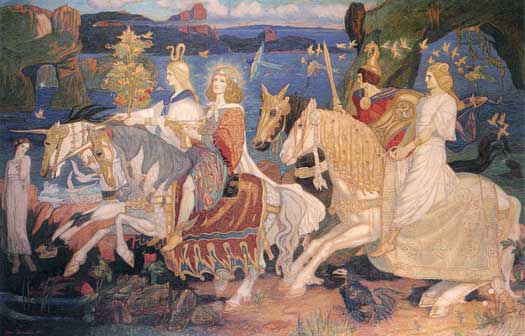
They arrived, say the oldest Irish books, not by ship but by sky. On the first of May, in a darkness of their own making, the Tuatha Dé Danann—the People of the Goddess Danu—descended upon the mountains of the west of Ireland in a magic mist, having burned their boats behind them so that retreat would be unthinkable, and the smoke of the burning, some scribes admit, may have been the mist itself. The admission is precious. Even the medieval monks who wrote the legends down could not decide whether the shining race came as gods descending or as men committing themselves utterly; and that undecidability is not a flaw in the record but the very signature of the Tuatha Dé. They are the great amphibians of European myth—divine and defeated, radiant and buried—and their story, from the cloud on the mountain to the door in the hill, is the West's most complete parable of what happens to the sacred when a new world refuses it lodging.
The Four Cities and the Four Treasures
Before Ireland, the legends say, the Tuatha Dé dwelt in four cities in the northern isles of the world—Falias, Gorias, Finias, and Murias—where they studied wisdom until they surpassed all the sages of the arts. The names alone are an incantation, and from each city they carried away one treasure, so that their arrival in Ireland was the arrival of a fourfold regalia.
From Falias came the Stone of Fál, the Stone of Destiny, which cried aloud beneath the foot of every rightful king—sovereignty made audible, the land itself given a voice in the coronation of its lords. From Gorias came the Spear of Lugh, against which no battle was ever won; from Finias the Sword of Núada, from which no enemy escaped once it was drawn from its sheath; and from Murias—city whose name murmurs of the sea—came the Cauldron of the Dagda, from which no company ever went away unsatisfied. Stone, spear, sword, and cauldron: earth, fire, air, and water; the student of the later esoteric traditions will recognize at a glance the four suits of the Tarot and the four implements of the ceremonial lodge, and more than one modern order has taught, quietly, that the four hallows of the Tuatha Dé are the elders of both families. The cauldron's own posterity is the richest of all, for the vessel of inexhaustible plenty passed from the Dagda's hearth into the romances by a road we have traveled before, from the Celtic cauldron to the Holy Grail itself.
A people defined by its luggage: that is the first mystery of the Tuatha Dé. Other invaders of Irish legend bring genealogies and grievances. The People of Danu bring instruments—a portable technology of sovereignty, victory, inevitability, and abundance—as though the myth wished to say that the sacred race is not a bloodline at all but a custodianship, and whoever holds the four offices holds the identity.
The Two Battles of Mag Tuired
Ireland was not empty. The Fir Bolg held it, and behind them brooded the Fomorians—misshapen powers of the sea and the dark, less a nation than a permanent undertow, the drag of chaos on every ordered thing. At the first battle of Mag Tuired the Tuatha Dé took the island; but their king, Núada, lost his right arm in the fighting, and by the deep law of the old faith a blemished king cannot reign, for the king is wedded to the land and the land will not have a maimed bridegroom. Here the legend produces one of its most instructive marvels. The physician Dian Cécht wrought Núada an arm of silver, perfect in every joint—and it was not enough. Only when the physician's son Miach sang over the stump, bone to bone and sinew to sinew, until flesh grew living again, could Núada resume the kingship. Artifice restores function; only regeneration restores sovereignty. The father, in a rage of professional envy, slew the son—and from Miach's grave grew three hundred and sixty-five herbs, one for each nerve of the body, which his sister Airmid arranged upon her cloak in their healing order until her father shook the cloak and confounded them forever. That is why, say the Irish, no physician now knows the full herb-lore of the human frame: the price of jealousy in the healing arts is paid by every sick man since.
In the interregnum the Tuatha Dé made their one fatal experiment: they gave the crown to Bres the Beautiful, half-Fomorian by blood, hoping to bind the two races. Bres was lovely and Bres was mean; under him the champions were set to digging and the Dagda to building walls, hospitality died, and the knives of the poets came out. Coirpre the satirist uttered against the king the first satire ever spoken in Ireland—a quatrain about empty dishes and darkness—and blotches rose on the royal face; blemished, Bres fell. Mark the sequence, for nothing in the saga is idle: the people who cannot be ruled by a maimed arm cannot be ruled by a stingy heart either, and in Ireland verse is a constitutional instrument—the satire enforces what the sword has not yet reached.
Then came Lugh to the gate of Tara: young, radiant, grandson of the Fomorian tyrant Balor on one side and of the Tuatha Dé on the other. The doorkeeper asked his art, for none entered Tara without one. Carpenter, said Lugh; they had one. Smith; they had one. Champion, harper, poet, sorcerer, physician, cupbearer, brazier—each art was answered with the name of its master already within. Then, said Lugh, ask the king whether he has one man who possesses all of them together—and the gate opened for the Samildánach, the Master of Every Art at once. At the second battle of Mag Tuired, Lugh faced Balor of the Evil Eye, his own grandfather, whose single lid, lifted by attendants with hooks, withered armies in its gaze; and Lugh's sling-stone drove the eye backward through Balor's skull so that its ruin fell upon the Fomorian host behind it. The destroying gaze, reversed upon the destroyers: the whole warfare of light against entropy compressed into one ballistic image. Chaos is not slain in the Irish scheme—the Fomorians are of the world's fabric—but it is turned, made to spend its malice on itself, and the harvest is bargained out of it: Bres, captured, purchases his life by teaching the ploughing, the sowing, and the reaping. Even the defeated dark must pay agriculture as its ransom.
The Defeat by the Living and the Doors in the Hills
And then, having won everything, the Tuatha Dé lost—strangely, gently, totally. The Sons of Míl, the ancestors of the mortal Gaels, came out of the sea; the poets negotiated where the armies paused; and in the settlement that followed, the defeated gods accepted the most extraordinary partition in the history of myth. The Milesians took Ireland above the ground; the Tuatha Dé took Ireland beneath it—the hollow hills, the sídhe-mounds, the ancient tumuli that stud the island like sealed doors, and with them the underside of reality itself. The Dagda, in the last act of his kingship, assigned each chief a mound: Newgrange, older than the pyramids, went in time to Óengus, god of youth and love, who won it from his own father by a riddle of Irish time—asked to lodge there "a day and a night," he observed that all time is only day and night, and so stayed forever. The gods diminished into the aos sí, the People of the Mounds—the fairies of the later peasantry, still riding out on the quarter-days, still exacting their courtesies, still glimpsed in the mist that had first carried them down. Their unconquered remnant lingered also in the west, on islands level with the horizon, in that country of youth beyond the waves toward which more than one Irish voyager steered by faith, as we have seen in the legend of Saint Brendan's navigation.
Esoterically, the partition is the treasure of the whole saga. The gods are not killed, exiled, or disproved; they are interiorized. The surface of the land—the daylight, the literal, the historical—passes to mortal administration; the depth of the same land remains divine. Ireland becomes a two-storey country, and the mounds are the stairwells. No European mythology states more plainly the destiny of the sacred in the age of the profane: driven from the surface of life, it does not depart but goes under, keeping its treasures intact in the dark of the psyche, accessible at thresholds—Samhain, Beltane, twilight, dream—when the doors in the hills stand open. The peasant who would not cut a fairy thorn and the mystic who will not profane an image are honoring the same statute of that old partition.
The four treasures, too, went into the keeping of the deep, and the tradition whispers that they are not lost but lent outward at need: sovereignty that cries aloud under the rightful foot, the spear of unlosable battle, the sword of inescapable consequence, the cauldron that satisfies. Every age finds them again under other names, and every finder is briefly of the Tuatha Dé. For that is the final teaching of the People of Danu, who burned their boats in the sky: the shining ones are not a race that was defeated long ago in Ireland. They are whatever in us surpasses the arts of the age, wins the daylight, loses it to newer and louder arrivals, and then—rather than die—takes the treasures down into the hollow hills of the soul, and waits for the quarter-days.
Lux Esoterica.
2026.


Comments